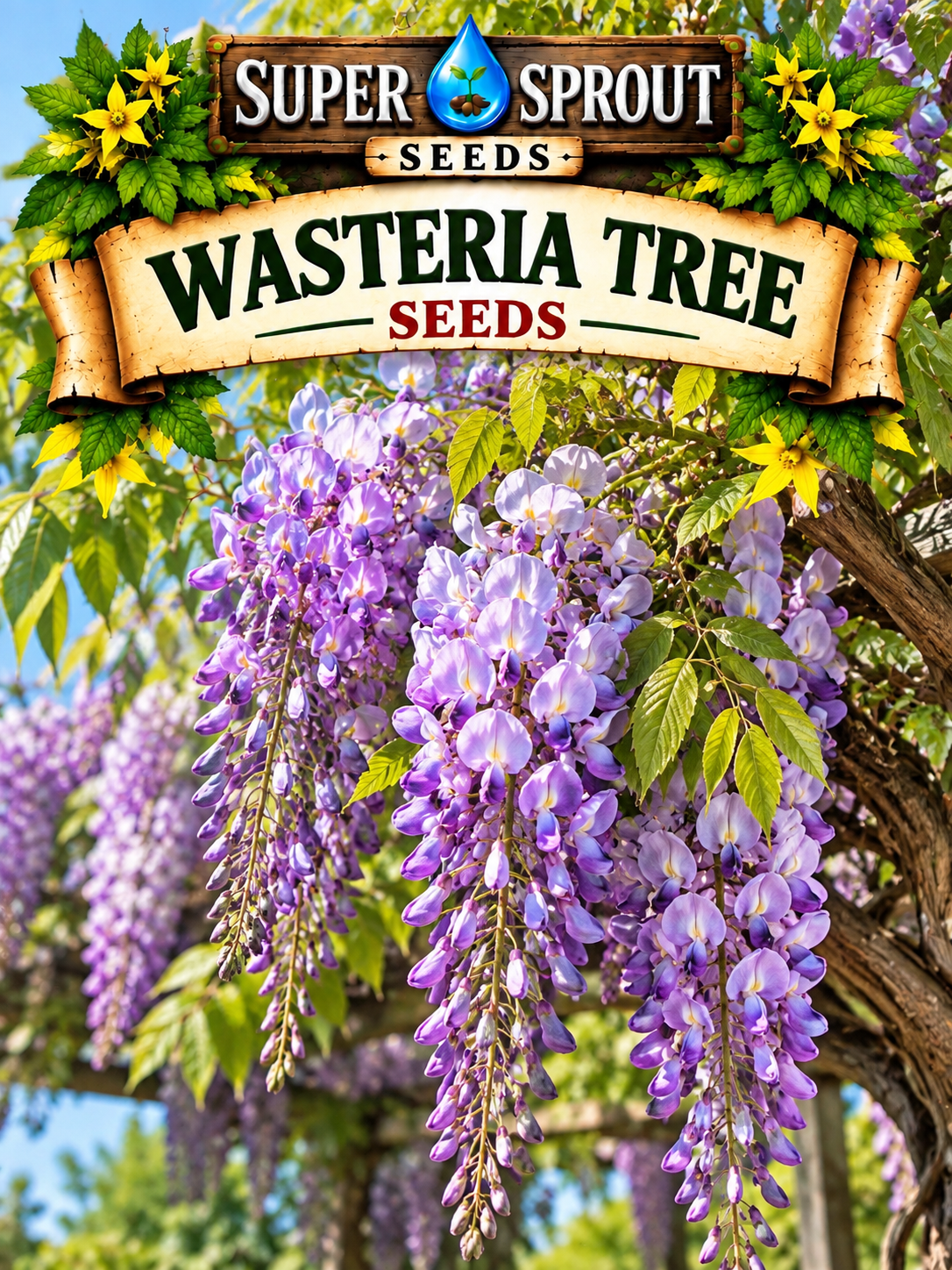
🌸 WISTERIA TREE SEEDS 🌸
Create a breathtaking garden feature with the spectacular Wisteria. Famous for its cascading clusters of fragrant purple-lilac flowers, Wisteria can transform a pergola, arch, entrance or sunny garden structure into an unforgettable floral display.
Wisteria is a vigorous, long-lived woody climber that can also be carefully trained into a beautiful free-standing tree or standard form. Its hanging flower clusters and lush green foliage make it an outstanding ornamental plant for gardeners who enjoy growing something truly special.
🌿 Vigorous, long-lived perennial climber
🌸 Cascading purple-lilac flowers
🌺 Beautiful fragrant spring display
☀️ Best flowering in full sun
🌳 Can be trained as a tree/standard
🏡 Excellent for pergolas, arches and strong supports
🌱 Grow your own Wisteria from seed
IMPORTANT: Wisteria grown from seed requires patience. Seed-grown plants can take many years to reach flowering maturity and may not produce flowers identical to the parent plant.
⚠️ CAUTION: Wisteria is ornamental and NOT edible. Seeds and seed pods are toxic if eaten. Keep away from children and pets.
🌱 SUPER SPROUT SEEDS
PLANT TODAY. GROW SOMETHING EXTRAORDINARY.
🌸 WISTERIA TREE SEEDS
FULL GROWING INSTRUCTIONS
🌱 SEED PREPARATION
Wisteria seeds have a hard outer seed coat. Dry seeds should be soaked in water for approximately 24 hours before sowing.
For particularly hard seeds, gently rubbing a small area of the seed coat with fine sandpaper can help water penetrate. Take care not to damage the inside of the seed.
🌱 SOWING
Fill individual small pots or seedling containers with a good-quality, free-draining seed-growing mixture.
Sow each seed approximately 2 cm deep.
Water gently after sowing so that the growing medium is evenly moist but not waterlogged.
Keep the pots in a warm, bright, protected position.
💧 WATERING
Keep the growing medium lightly and consistently moist while waiting for germination.
Do not leave the pots standing in water. Constantly saturated soil can encourage seed and root rot.
Once seedlings are established, allow the surface of the growing medium to begin drying slightly between waterings.
🌱 AFTER GERMINATION
Give young seedlings plenty of bright light.
When the seedlings are established and have developed a healthy root system, move them gradually into larger individual containers.
Do not suddenly move tender indoor-grown seedlings into strong outdoor sun. Acclimatise them gradually to outdoor conditions.
☀️ POSITION
Established Wisteria performs best in:
• Full sun for the best flowering
• A warm, reasonably sheltered position
• Fertile, moist but well-drained soil
• An area with plenty of room for future growth
Wisteria can tolerate some partial shade, but flowering is generally better in full sun.
🌿 SOIL
Wisteria adapts to a range of soil types provided drainage is good.
Improve poor soil with well-decomposed organic matter before planting.
Avoid permanently waterlogged locations.
🌳 PLANTING OUT
Plant young Wisteria into its permanent position once it is strong enough to cope with outdoor conditions.
Remember that Wisteria becomes a large, powerful woody climber. Choose its permanent position carefully.
If growing it as a climber, provide a very strong pergola, trellis, wires or other permanent support.
Do not rely on weak garden structures because mature Wisteria becomes heavy.
🌳 TRAINING AS A WISTERIA “TREE”
Wisteria is naturally a climbing vine rather than a true tree, but it can be trained into a free-standing standard.
Choose one strong main stem and secure it vertically to a sturdy stake.
Remove or shorten unwanted competing shoots while allowing the selected leader to develop.
Once the main stem reaches the desired height, encourage branching near the top to gradually form the crown.
Continue supporting the trunk while it develops sufficient woody strength.
Regular pruning will be necessary to maintain the tree-like form.
✂️ PRUNING
Wisteria responds well to regular pruning and training.
Established plants are generally pruned twice a year to control vigorous growth and encourage flowering.
Regularly remove unwanted growth and continue directing the main framework along the chosen support.
💧 ESTABLISHED PLANTS
Water young and newly planted Wisteria regularly while the root system establishes.
Established plants are more resilient, but should still be watered during prolonged dry periods.
Plants in containers require more frequent watering than plants growing in the ground.
🌸 FLOWERING — IMPORTANT
Growing Wisteria from seed is a long-term gardening project.
Seed-grown plants can take many years to produce their first flowers, and the Royal Horticultural Society notes that they may take up to 20 years.
Seed-grown plants can also vary from the parent plant, so flower colour, size and other characteristics cannot be guaranteed to be identical.
This is normal for seed-grown Wisteria.
🇿🇦 SOUTH AFRICAN GARDENS
In South Africa, aim to establish young plants when temperatures are moderate rather than during extreme summer heat.
In winter-rainfall regions such as the Western Cape, pay particular attention to summer watering while plants are young and establishing.
Choose a sunny position with good drainage and enough space for the mature plant.
⚠️ IMPORTANT SAFETY INFORMATION
Wisteria is an ORNAMENTAL PLANT and should not be eaten.
The seeds and seed pods are particularly toxic if swallowed, and other parts of the plant can also be harmful.
Keep seeds, pods and plant material away from young children and pets.
🌱 SUPER SPROUT SEEDS
PLANT TODAY. GROW SOMETHING EXTRAORDINARY.